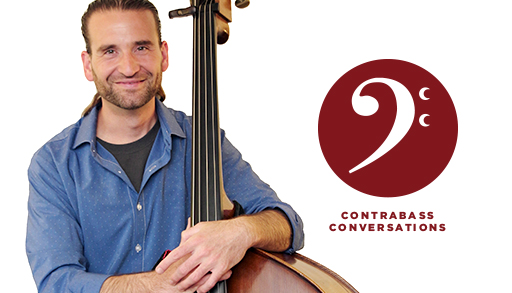
Today’s episode features double bassist Jerry Fuller. I’ve known Jerry for well over a decade at this point and have found him to be such an interesting person. Jerry is best known in the music world for his work in period performance—in fact, he won an award for historically informed performance from the International Society of Bassists in 2015, and he is also a former ISB board member.
217: Jerry Fuller on early music, creativity, and business world lessons
216: Todd Coolman on jazz bass lines, recording projects, and classical foundations
Today’s podcast features an interview with Todd Coolman, who has just released his latest album Collectibles. Todd is actually playing a CD release event tonight at Smoke Jazz Club in New York City to celebrate the release of the album, which also features Bill Cunliffe on piano and Dennis Mackrel on drums. This is the second time Todd has appeared on the podcast—you can hear his interview with Win Hinkle in our archives.
Todd and I cover all sorts of interesting topics in this interview, including his experiences moving from a full-time faculty position down to part-time and the opportunities that opens up for him. We talk about his classical foundation on the bass and dig into classical and jazz crossover and how lessons learned in one genre are valuable in the other. We also talk about skills the modern music student needs to be successful and what colleges can do to help facilitate this, and we get into details about recording this new album.
If you enjoyed this episode, check out our interviews with Carlos Henriquez, Chuck Israels, Larry Gray, Ron Carter, Lynn Seaton, and Rufus Reid!
215: Robin Kesselman on audition strategies, injury recovery, and bow arm practicing

Houston Symphony principal bassist Robin Kesselman
Today’s episode features Houston Symphony principal bassist Robin Kesselman. Robin studied with David Allen Moore and Paul Ellison at the Coburn School of Music and the University of Southern California, and with Hal Robinson and Edgar Meyer at the Curtis Institute of Music. He has also performed as Guest Principal Bass with the Saint Paul Chamber Orchestra, travelled internationally with both the Philadelphia Orchestra and the Los Angeles Philharmonic, and performed with the National, Atlanta, and Baltimore Symphonies.
During Robin’s time at USC, he sustained a playing injury that took him out of commission for a prolonged period. We dig into how Robin ultimately recovered from this and how it changed his approach to practicing and performing on the bass, and how he practiced while he was out of commission. This was a left arm injury, and Robin continued to practice open string and harmonics with the bow, going into his lessons and working on the Bottesini Concerto on open strings. We also discuss how Robin approaches the audition process: his preparation strategies, his musical goals for an audition, and using visualization techniques.
We also feature excerpts from Krzysztof Penderecki’s Duo Concertante with Eunice Kim on violin. Enjoy!
Interview Highlights
Discoveries During Playing Injury:
- sitting in practice room – “this hurts, but it also still sounds bad” – the mistake of pushing through pain
- this time spent not using his left hand ultimately took his bow game to a new level – he spent large amounts of time just practicing with the right hand – playing solos and excerpts on open strings / harmonics in lessons!
- “the building blocks with which I was making my shapes were not completely honest” – referring to the bow arm
- mental practice / visualization – he got into this during this time period
- learning the difference between an ache and something more serious
Thoughts on Auditioning:
- there’s nothing that isn’t practicable
- timing and pulse
- mathematical pulse/note division vs. feeling right
- the fallacy of perfect audition rounds
- similarities between prepping for an audition and a recital
- auditions have to be an artistic endeavor and about musical expression
- if you walk out and your whole goal is to play notes that are even and in tune, the second that one note isn’t exactly the same as another note you officially have nothing left to offer, because your single goal has crumbled
- if your goal is to make lines and to make shapes and be expressive, it’s ok if one note is a little shorter than the others
- philosophy from David: as soon as you come in and things are in tune and in time, you are officially at zero
The Audition Process in Detail:
- record constantly during this whole process -throughout the whole day
- first 50% of the interval
- really hibernate and work things super slow – considerably under 50% tempo
- move something up 40 clicks over a period of weeks
- A and B lists that kind of parallel each other (one Mozart Symphony on one and one on the other, for example)
- doesn’t play for anyone during this time – nothing’s put together – it’s all really cut up at this point
- next 25%
- buff out the edges, smooth out the music, give it a shine
- playing with recordings, getting the flow right
- last 25%
- take the show on the road, play for anybody and everybody, start setting up mock auditions and lessons with other (non-bass) instrumentalists
- the last week
- go back to “hibernating”
- stop playing for people – running rounds – 4-5 excerpts in a row
- hours wise it’s similar through he whole process, but the hours are being used differently
- all the way until audition time, there was never a day/time when he could not continue to make things better
- have a specific game plan for those 20 minutes of warm-up once you arrive at the hall
- bass players don’t hire bassists – committees of other instrumentalists do
214: Terry Plumeri tribute
Today’s episode is a tribute to bassist, film composer, and conductor Terry Plumeri, who was found murdered in his home in Florida on April 1st of this year. This episode features comments from former Terry Plumeri student Eric Swanson plus some recordings of Terry performing and conducting. Learn more about Terry’s bass playing in this For Bass Players Only article.
Tracks featured:
- Footprints from Blue in Green (Terry on bass)
- Windflower (Oboe Concerto) – Moscow Philharmonic
- Pride of Baltimore – Moscow Philharmonic with Terry conducting
- Across a River’s Dream – Boguslaw Furtok, bass
- Tchaikovsky Symphony No. 5 – Moscow Philharmonic with Terry conducting
213: Leon Bosch – the Sherlock Holmes of the double bass
Leon Bosch is a remarkable figure in the world of the double bass. From his early years growing up in South Africa to his long tenure with the Academy of St Martin in the Fields and his proliferation of solo projects, Leon has approached each challenge with a focus and determination that are incredibly inspiring. This is a “must listen” episode for any musician eager to realize their greatest potential.
After retiring from the Academy of St Martin in the Fields to devote himself fully to solo, chamber, and conducting projects, Leon has been working to bring undiscovered treasures of the repertoire to light and to encourage new works for the double bass from composers. New composition are being written for Leon from South African composer Péter Louis van Dijk, British composer Paul Patterson, and American jazz icon Wynton Marsalis.
This episode is sponsored by Discover Double Bass, and they have a course on bowing technique with Lauren Pierce that I highly recommend checking out. This course is divided into 37 HD lessons, and Lauren gives a short video overview of the three categories that these videos cover: the basics, bow control, and real world techniques. There’s also a free preview lesson on phrasing with the bow—check it out!
We feature excerpts from Leon’s latest album throughout the episode. Check out Leon’s excellent albums (available both as digital downloads and CDs):
- Music of Rankl Sprongl & Hindemith (latest album)
- British Double Bass
- Russian Double Bass
- Catalan Virtuoso
- Virtuoso Double Bass Vol. 1 – Giovanni Bottesini
- Virtuoso Double Bass Vol. 2 – Giovanni Bottesini
- Pedro Valls – Music for Double Bass & Piano
If you’re enjoying these episodes, I’d love it if you’d give us a quick review on iTunes! These reviews help us with discoverability and they give me great feedback about how I can keep working on the podcast to make it as valuable as possible for you. Leave a quick star rating and if you could even jot down a sentence or two that would be great. You can also leave a review for our iOS, Android, and Kindle apps.
- Prev Page...
- 1
- …
- 182
- 183
- 184
- 185
- 186
- …
- 227
- ...Next Page


